
Propositions, Predicates, and Quantifiers
The vocabulary of mathematical statements: propositions, predicates, and the quantifiers that turn predicates into propositions.
Start Learning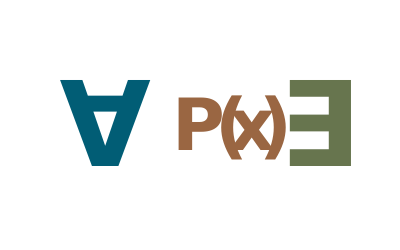
Learning Objectives
On completing this unit, the student will be able to:
- State precisely what counts as a proposition and distinguish propositions from questions, commands, opinions, and parametric statements.
- Assign the correct truth value to a proposition and articulate the principles of bivalence, non-contradiction, and tertium non datur.
- Define a predicate and identify its variables and domain of definition.
- Determine the truth value of a closed atomic formula obtained by substituting values for the free variables of a predicate.
- Read, write, and interpret formulas built with the universal (∀) and existential (∃) quantifiers, including statements with several quantifiers.
- Recognise that the order of nested quantifiers of different types changes the meaning of a statement.
- Translate ordinary mathematical claims into the formal language of predicates and quantifiers, and back.
About This Course Unit
This unit fixes the basic vocabulary of mathematical reasoning. We begin with the proposition — the smallest unit of mathematical assertion — and the two truth values it may take. We then generalise to predicates: parametric statements whose truth depends on the values assigned to their variables. The unit closes with the universal and existential quantifiers, the operators by which a predicate is bound to a domain to yield a proposition. By the end of this unit the student commands the language in which all subsequent material is expressed.